
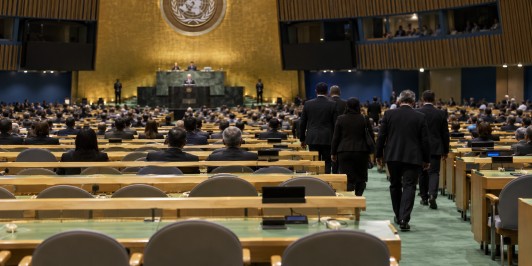
The United Nations General Assembly witnessed diplomatic tension as representatives from Iran and Cuba exited the assembly during a speech by U.S. President Donald Trump. The walkouts occurred against a backdrop of escalating U.S. criticisms of both nations, highlighting the persistent geopolitical strains.
During his address on September 22, President Trump took a firm stance against Iran, discussing U.S. military actions and cautioning that further measures could be implemented if no agreement was reached. This prompted the Iranian delegation to leave the chamber. Notably, Iranian President Masoud Pezeshkian and Foreign Minister Abbas Araghchi were in New York for the assembly, though they were not present during Trump’s remarks.
The situation intensified when Trump urged other nations to apply economic pressure on Iran, emphasizing the United States’ strategic choices between diplomacy and additional action against the Islamic Republic. These comments underscored the ongoing tensions between Washington and Tehran.
Later in his speech, Trump turned his attention to Cuba, denouncing it as a “failed state” and expressing a desire for significant changes on the island. The Cuban delegation responded by exiting the assembly, marking their disapproval of Trump’s assertion that the U.S. would prevent foreign adversaries from establishing a foothold in Cuba and his prediction of impending freedom for the nation.
These walkouts during Trump’s address punctuated an event where world leaders gathered to discuss international issues, reflecting the contentious nature of U.S. foreign policy positions regarding Iran and Cuba. The incidents highlight the challenges and diplomatic rifts facing the current global political landscape.